17 August
15 min read
How to Heat Your Rental Campervan in Iceland


6 July 2026
15 min read
No, you can’t sleep anywhere in a campervan in Iceland. At Campervan Reykjavik, this is one of the first things we have to correct at pickup because it’s the most common and expensive misunderstanding visitors often get from outdated blogs or incorrect social media posts. The reality is simple: overnight stays in campervans are only allowed in designated campgrounds or on private land with the owner’s permission.
Iceland’s camping laws are largely outlined in the Nature Conservation Act (Act No. 60/2013), which was last updated in 2015 to clarify and reinforce wild camping restrictions. Under the law, you may camp with a traditional tent on uncultivated ground for one night only, with a limit of 3 tents, provided you are far from a designated campground, it isn’t prohibited by signage, and you are not close to a farm or inhabited area. This is a narrower version of the “right to roam” found in other Nordic countries.

If you plan to do anything other than the above, you are required to seek permission from the landowner first. In addition, local regulations can sometimes be stricter than the national laws.
Overall, the rules are stricter for those traveling in a vehicle like a campervan. Camping in campervans, motorhomes, rooftop tents, or cars is not allowed outside legal campgrounds, unless you have explicit permission from the landowner. For most visitors, this means staying in a campground every night.
Protected areas and national parks have their own set of rules. In these areas, camping is restricted to official campgrounds in all situations. Today’s wild camping rules are designed for remote hiking, not casual tourism. With a large network of campgrounds throughout the country and high fines for not complying, there’s no reason not to stay in one.
The big question many visitors have is what legally counts as “camping” in a campervan? You may wonder if you can stop in a parking lot to take a quick nap to refresh for the drive or whether you’re allowed to park somewhere for a hike. In legal terms, “camping” refers to staying overnight in a vehicle. This means you are camping if you pull over to sleep for the night, or you intend to sleep for the night.
So, what if you plan to take a power nap during the day for your own safety? Knowing the difference between taking a safety nap and staying overnight is vital to avoid fines. By definition, a safety nap is a short, unplanned rest that can last 20 minutes to a couple of hours, provided it clearly isn’t an overnight stay. Overnighting generally refers to parking with the intent to sleep for hours at a time, essentially using the campervan as accommodations.

In practice, the distinction between a safety nap and overnighting lies in the context. Stopping in one place for hours overnight, parking in scenic or secluded spots to sleep for long periods, or repeatedly returning to the same location to sleep are all generally considered camping. However, if you make a brief stop to rest before continuing due to fatigue, you are free to do so.
In short, if you’re resting for a short period for safety reasons, you are okay. However, if you’re setting up camp to cook and sleep for the night, you can be fined and asked to move on.
Now that we’ve established what Icelandic law says about wild camping, let’s take a closer look at where you can legally sleep in your campervan in Iceland. In short, you will most likely have to find designated campgrounds along your path, but there are still some potential exceptions. This is exactly what we tell customers at pickup with Campervan Reykjavik.
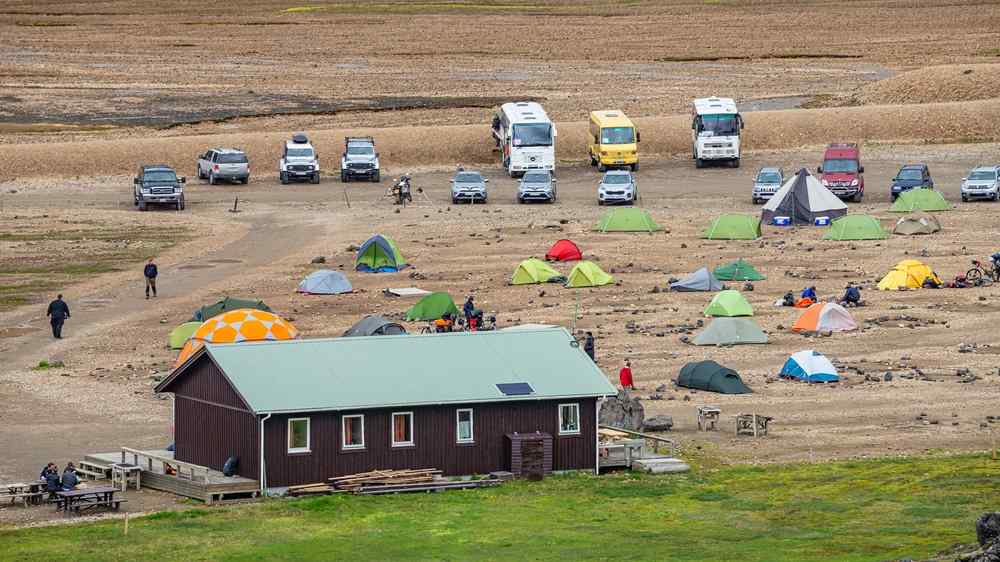
Registered campsites are scattered throughout the country, with more than 200 to choose from in the summer. We recommend using tjalda.is, a website that lists many of Iceland’s campgrounds, along with information about fees, facilities, and opening dates. Most of them have toilets, showers, waste disposal, and other essentials. In the summer, many visitors are pleasantly surprised by how easy it is to get a spot in a campground as long as they don’t arrive quite late.
The only exception to staying in approved campgrounds when traveling in a campervan, motorhome, or another camping vehicle is seeking landowner permission. However, this is easier said than done. What catches most people out is that what appears to be open land is actually privately owned, even in remote areas. Identifying the owner of a particular piece of land can be challenging or even impossible for a visitor. If you do manage to locate a landowner, you can seek permission to stay, but they are not obligated to allow it.

Summer is peak camping season in Iceland, so not all campgrounds stay open after the summer season. However, there are some year-round options if you are visiting outside the main camping season. These campgrounds are usually found along primary routes and near key sights. Despite the reduced number of open campgrounds, you are still legally required to stay in one.
Some examples of year-round campgrounds in Iceland include:
Knowing where you cannot sleep is essential to protect you from fines and being woken up in the middle of the night by a park ranger or police officer asking you to move on. Even if the spot seems quiet, remote, and out of the way, you are still required to head to the nearest campground to stay for the night.
These are exactly the types of spots where tourists are woken up at 2 am by a park ranger to receive a fine. These spots may seem convenient and quiet for the night, but they are considered parts of the public roadway and not allowed for overnight camping. Staying here overnight is forbidden, even if you’re discreet and don’t set up any equipment. This is where most fines happen.
National parks, nature preserves, and protected areas do not allow overnight stays. Major tourist attractions and popular natural spots are closely regulated, and trying to stay in these locations, even if they are remote, can result in fines.

Inhabited land or land near farms or homes may be tempting, but you’ll have to move on. Even if you don’t see signs or no one seems to be using the property, staying close to these areas is generally illegal. The same applies to cultivated land like farm fields, grazing fields, and other agricultural land.
Many locations in Iceland are quiet and make you feel like you’re alone, including coastal areas, forest clearings, or Highland access roads, but these aren’t places to camp. If an area isn’t a designated campground or you don’t have landowner permission, you must seek out the nearest campsite.
Many travelers who book a campervan to tour the country aren’t fully aware of the rules and incorrectly think certain scenarios exempt them from staying in a campground. Learning about these scenarios can help you avoid getting into legal trouble in the middle of your adventure. Remember, illegal wild camping is the moment when a great trip can become stressful.
Seeing other campervans parked in a remote location is one of the biggest reasons travelers think it’s okay to sleep anywhere in a campervan in Iceland. However, even if you see several vehicles in a roadside pull-off, it doesn’t mean they are legally camping. If it’s not a valid campsite and you don’t personally have landowner permission, it’s best to move on.

The good news is that most campgrounds in Iceland rarely fill to capacity, but what do you do if the campground is full when you arrive? A full campground doesn’t give you the license to camp just anywhere nearby. You are legally required to move on to the next campsite. To avoid this problem, book ahead when possible, arrive early, or keep a list of alternative options handy.
Many campsites have a self-service check-in that makes it easy to arrive after hours. Even if you arrive after the reception has closed, you are welcome to stay and pay in the morning. If a campground is truly closed or inaccessible, you are required to continue to the next available campground. A random roadside location is not an option just because you arrived late.
Adjusting your plans for bad weather is a must for your Iceland vacation, but that doesn’t mean you can just camp anywhere if the weather turns. Stopping for severe weather, fatigue, or unsafe driving conditions is understandable, and a short stop for a rest for these reasons is not the same as overnighting.
The only time this may be overlooked as an illegal overnight camping situation is if the conditions remain too poor for driving and there is no acceptable campground close enough to safely arrive. The law prioritizes safety, but that doesn’t automatically mean illegal camping will be forgiven unless it’s a true emergency.
Some people mistakenly think that the wild camping rules only apply to rural areas, not urban areas. However, parking your campervan for sleeping in towns, urban parking lots, or near housing is strictly forbidden and often more closely monitored. Most land in urban areas is privately owned and would require landowner permission for overnight stays. You can park your campervan in a town if you are spending the night in other accommodations, though.

If you are caught camping outside a designated campground and don’t have written proof of landowner permission to be there, you will face fines and be asked to move on to a legal campground. The actual amount varies depending on the severity, location, and whether you harmed the environment, but the fines start at 50,000 ISK (~$410 USD). Repeated offenses, staying in a protected area, or causing environmental damage can lead to fines of over 100,000 ISK (~820 USD).
Enforcement is strict, especially in populated or more popular tourist areas, but that doesn’t mean camping in a more remote area is acceptable and carries a low risk. Park rangers and police officers could be knocking at your door in the early morning hours, issuing a fine on the spot. They may also issue a fine through the vehicle registration, resulting in administrative fees from your rental company.
A fine isn’t the only thing you have to worry about if you park your campervan overnight where it doesn’t belong. Your rental car insurance with Campervan Reykjavik is based on following the local laws. One of those laws is that camping is only allowed in approved locations. Failing to follow the laws is often considered a violation of your policy terms.
If your rental is damaged or theft occurs while illegally camping, the insurance company may reduce or decline your coverage. This is typically the case when:

Even if your insurance still covers the instance, you may be subject to a higher deductible or exclusions. Be sure to read your insurance paperwork carefully. You may also be charged administrative fees by the rental company.
At Campervan Reykjavik, we recommend the following campsite route around the Ring Road:
Camping may be one of the most flexible ways to see Iceland, but you still need to do a little bit of planning. At a minimum, you should choose your camping spot before you stop driving for the night to give you a target, because “we’ll figure it out later” often leads to parking where you shouldn’t. Here are a few tips from our Campervan Reykjavik team:

Our team at Campervan Reykjavik often fields the following questions at pickup.
No, you cannot just park and sleep anywhere for the night in your campervan. In Iceland, you are legally required to stay in a designated campground. The only exception is if you have permission from the landowner.
Being discreet isn’t the issue. In Iceland, traveling in a campervan requires staying in official campgrounds, no matter what.
In some situations, yes, you can certainly pull into a safe place and take a short nap to refresh yourself for driving. Staying in random locations with the intention to sleep for the night is illegal, except in rare emergencies when driving is unsafe.
You should always have a backup campground lined up for these situations. If you reach a campground that is full or closed, you are expected to drive to the next one.

In some ways, yes. Wild camping in tents is allowed in some situations, such as remote hikes far from designated campgrounds. However, campervans and other camping vehicles are required to stay overnight in campgrounds at all times unless they have landowner permission.
The best thing you can do is plan your nightly campground stops ahead of time, always having at least one backup plan. Only rely on approved campgrounds and check opening dates carefully to avoid showing up at a closed campsite.
When renting a campervan in Iceland, you gain the flexibility to see the country at your own pace. However, with wild camping strictly forbidden for campervans and similar vehicles, it’s important to know where you can stay to avoid fines and unnecessary stress. Follow the rules, and we’ll make sure your trip is safe, simple, and exactly as it should be: freedom without surprises.
Inside this article
More Iceland Stories to Explore
Discover more tips and tales to fuel your next saga
Join thousands who have booked with us
Iceland's most booked campervan of 2025 is waiting. Secure yours today!
Your rental comes with:
Handy Extras
Essential Insurance Plan
Unlimited Mileage
Flexible Cancellation